

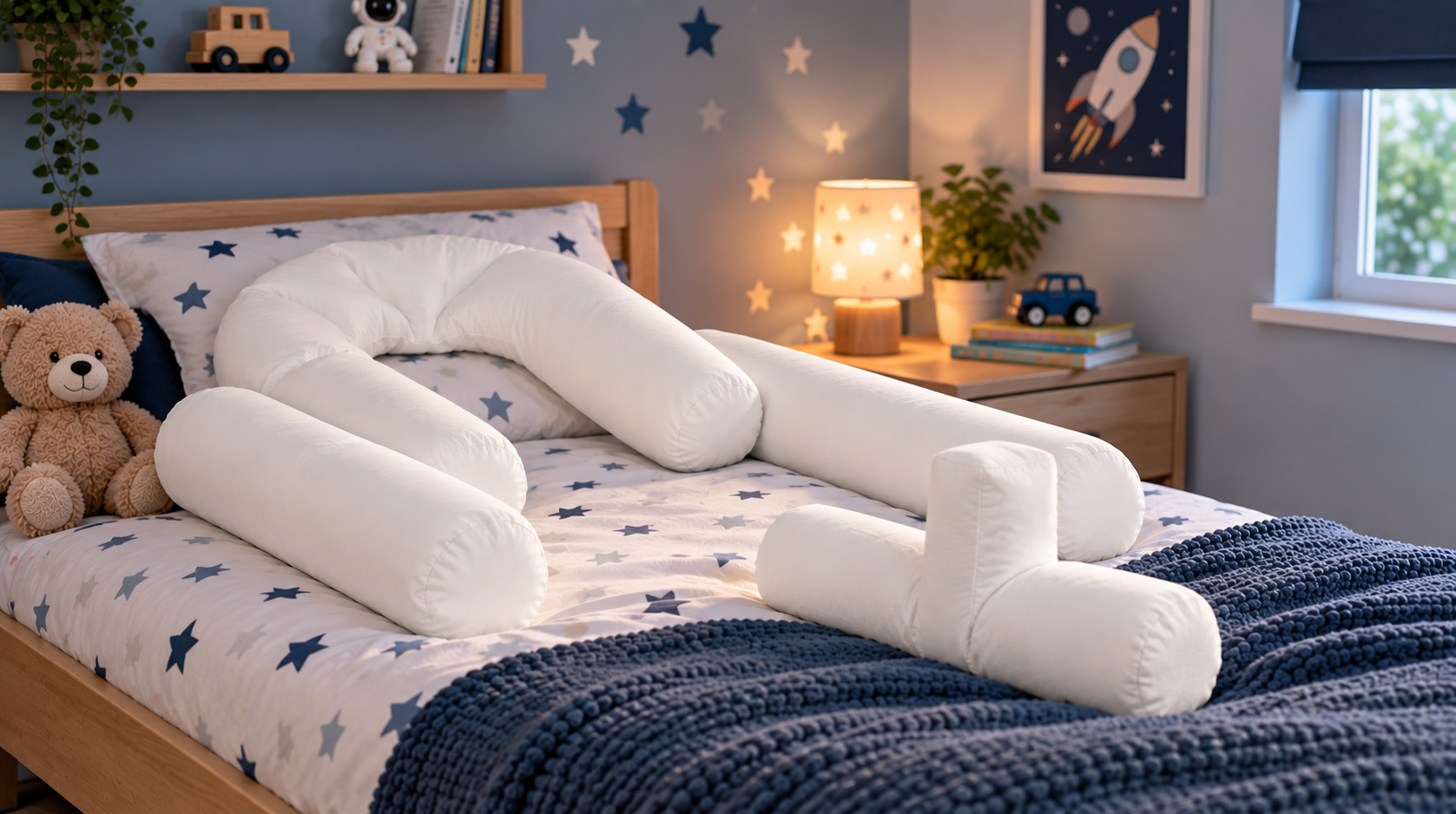
Our sleep systems are modular positioning components that help maintain a symmetrical posture while lying, both at night and during the day as part of a 24-hour postural management programme. This case study follows a 10-year-old pupil at a specialist education centre, assessed and trialled by the school’s senior physiotherapist.
Case study: 10-year-old with quadriplegic cerebral palsy
- Setting: Specialist school (Victoria Education Centre, Poole, Dorset). The school has 95 pupils aged 3 to 19, supported by a physiotherapy team of five.
- Components prescribed: Horseshoe (9014) Size 2 with 3 inner cushions, Star (9021) Size 2 and 2 x sheets, used on his Acheeva bed. He also received a Snooze W leg trough (9005) Size 2 with wrap, used with his existing sleep system.
- Trial length: Short trial
- Assessed by: Carolyn McNally, Senior Physiotherapist
Background: The pupil has quadriplegic cerebral palsy with associated profound learning difficulties. He also has bilateral hip dislocation and spinal scoliosis. Pain, probably linked to his orthopaedic problems, was increasing his extensor patterns of movement. This made it hard for him to settle in his existing sleep system and in his wheelchair seating.
As part of his 24-hour postural management programme, he spends time out of his seating each day lying on his side. He needed a system that would hold him in a good position to protect his hips and spine, while still letting him take part in classroom activities.
Assessment: Lying on his back, both legs fell together and rotated inwards, with his left side considerably worse than his right. His extensor patterning made this worse and pushed his hips into a poor position. He tended to turn his head to the right, which triggered his asymmetric tonic neck reflex (ATNR). His trunk leant to the left, with pelvic obliquity and rib asymmetry.
Results: During the trial he was positioned more comfortably and held in a more symmetrical posture. When his tone increased and he went into extension, he relaxed back into the system well and needed minimal repositioning.
The Star cushion kept his head well positioned. His physiotherapist found it especially helpful that each arm of the Star could be adjusted individually, so his position could change between working in class and relaxing. The Horseshoe could be repositioned quickly and accurately each time he was turned from side to side. This helped keep him comfortable and reduced the likelihood of his scoliosis deteriorating further.
Summary
In a short trial, Smirthwaite sleep system components gave this pupil a more comfortable, symmetrical lying position that held up even through his extensor patterning. They were also quick for staff to reposition, supporting his 24-hour postural care both in class and at rest.
Find out more about our sleep systems
Download the full case study (PDF)
For advice on whether a sleep system is right for a child, get in touch with our team.