

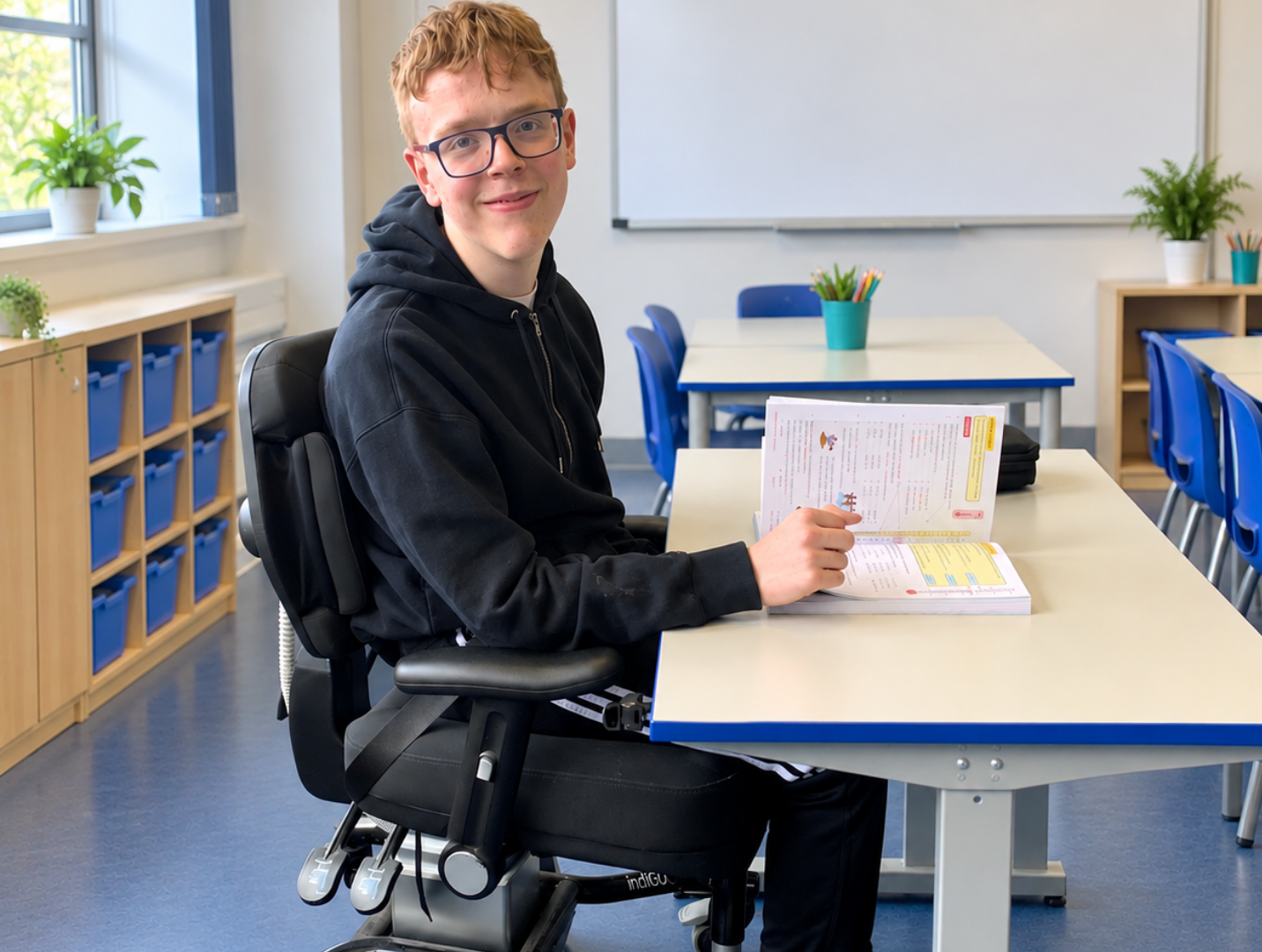
The IndiGO is an electric height-adjustable seating system designed to support posture while giving users the independence to self-adjust their position throughout the day. This case study follows a 15-year-old student with quadriplegic cerebral palsy over an extended trial in a mainstream secondary school.
Case study: 15-year-old with quadriplegic cerebral palsy
- Setting: Mainstream school (Dalkeith High School, Midlothian)
- IndiGO size: Size 5
- Trial length: 3 years (started 20/3/2024), used roughly 2 hours a day, Monday to Thursday, 1 hour on Fridays
Background: The student’s previous seating had been assessed by his occupational therapist and met his needs for posture, support and mobility. The IndiGO was trialled to build on this — particularly to support independent transfers and self-adjustment across the school day, where desk heights vary by subject.
Results: The chair gave him a neutral pelvis, a symmetrical upright spine, and enough head freedom to move and engage without needing head support accessories. Footplate accessories helped position his legs and feet for abduction, adduction and flexion. The electric height, swivel and tilt functions meant he could transfer independently from his wheelchair and find a comfortable working position without relying on others — something he said helped him concentrate and stay focused rather than being distracted by constantly readjusting himself, a particular issue given his condition.
Supervising therapist/carer rated the chair excellent across appearance, adjustability, ease of adjustment, manoeuvrability, overall ease of use and ease of transfer. They noted tilt-in-space could be a helpful addition for maintaining pelvic position, and that the electric height adjustment was “an essential requirement” for desk-height transfers throughout the school day. The one drawback raised was cost — enough to make a second chair for home use difficult to justify.
In his own words: He rated the chair excellent for looks, ease of use and comfort, and said the electric height adjustment let him fully participate in practical science and home economics classes with minimal support from his learning assistant. He said it helped with his jerkiness, meant he could concentrate better in class, and that his mainstream classmates thought the chair was “cool” and wished they had one too. His one wish: he’d prefer it in blue, and found it a little bulky for fitting into normal classrooms. He said he’d like to keep using the chair, and that it had made him “more independent, comfortable and safe.”
Summary
Over a three-year trial in a mainstream school, the IndiGO supported independent transfers, postural stability and sustained classroom participation, with strong ratings from both the supervising carer and the student himself.
Find out more about IndiGO
Download the full guidelines (PDF)
For advice on whether IndiGO is right for a child, get in touch with our team.