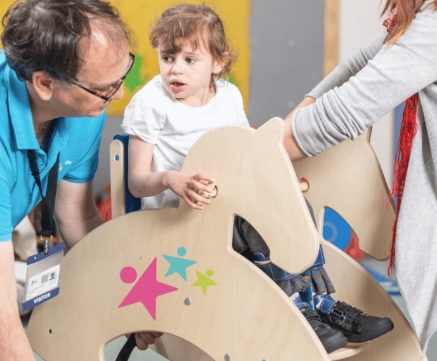


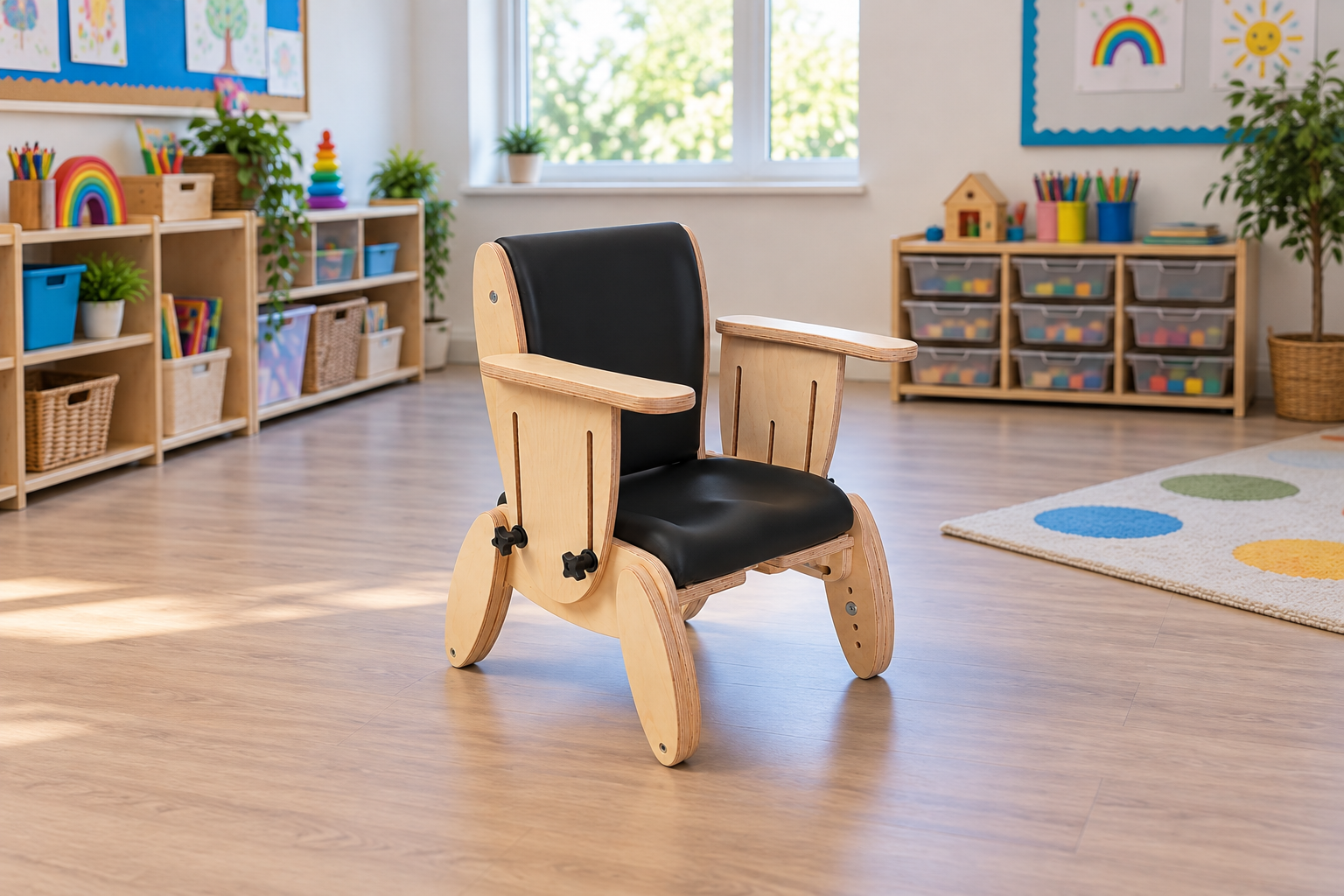
The Juni is a highly adjustable postural support chair for young children. Its contoured seat and backrest support the pelvis and thighs, giving discreet support without looking or feeling medical. These case studies follow three children aged two and three, in the home and nursery, over trials lasting from six weeks to five months.
Who is Juni suitable for?
Juni is designed for children who:
- have weakness in the lower limbs or trunk, for example children with developmental delay, Down syndrome or cerebral palsy
- have some postural control of the upper trunk and head
- are able to abduct at the hip
- would benefit from a stable, comfortable, upright posture at home, at nursery or in the classroom
Juni may not be suitable for children with marked kyphosis or scoliosis, hip contractures that prevent a stable base of support, insufficient head control, or marked hip subluxation or dislocation. These are general guidelines, and each prescription should be considered on an individual basis. For more detail, see the full clinical guidelines in the PDF below.
Case study 1: 2-year-old with increased tone in his right hand
- Setting: Home (receives Portage)
- Juni size: Size 2
- Chailey level of sitting ability: 7
- Trial length: 5 months
Background: An alert, lively and petite two-year-old who walks independently with a wobbly gait. The tone in his right hand increases when he tries to play or feed himself, so he finger-feeds with his left.
He previously used a child-sized canvas folding garden chair. It sloped backwards, so he sat on the base of his spine with a rounded back and his feet off the floor, and he struggled to get on and off it. His table was too high, leaving his elbows unsupported, so he couldn’t see what he was doing.
Goals: A chair with minimal, discreet elbow and trunk support to encourage him to use both hands for cutlery, messy play, and cooking and baking with Mum. The aims were for his right arm to cross mid-line, and for him to get on and off his chair independently.
Assessment: He was first offered a Brookfield size 1, which was far too big and left his feet unsupported. A Juni size 1 fitted, but only at almost maximum height and depth, so a size 2 was recommended to give him room to grow. Mum said: “Big improvement to the garden chair… I like the Juni for its size, style and simplicity, it looks cute and fits into our home.”
Results after 5 months: He now sits with an upright spine, his weight evenly spread over his pelvis and his feet firmly on the floor. He gets on and off the Juni independently and can pull it up to the table himself. He has been threading, playing with play-doh and using a rolling pin with both hands when baking with Mum. He also draws with his left hand while propping himself with his right. The table cut-out lets him sit up close and get the discreet support he needs. Mum found the height and seat depth easy to adjust.
Case study 2: 3-year-old with cerebral palsy
- Setting: Home
- Juni size: Size 2 with quick release tray and 2 x 25mm side support cushions
- Chailey level of sitting ability: 6
- Trial length: 6 weeks
Background: A highly motivated three-year-old who can stand, weight bear, commando crawl and long sit without support. He previously used a Heathfield size 2 with footboard and tray, which he loved; Mum said it was “a hit from the beginning”. However, he couldn’t learn to transfer independently. He would kneel on the footplate to climb in, then get stuck because the footplate stopped him turning around.
Goals: A chair with minimal support for play and functional activities at home, which would let him learn to climb on independently.
Assessment: At its lowest setting, the Juni let his feet rest on the floor with good support, so he didn’t need a footplate. This seat-to-floor height meant he could push up on the armrests to stand, and learn to climb on by himself. The side support cushions gave extra hip and thigh support. Mum said: “I certainly won’t miss the footplate.”
Results after 6 weeks: He can push to stand from the Juni independently. He initially leant to the right, but this improved significantly once Mum raised the armrests. He prefers using the quick release tray for its snug fit around his trunk, and uses it for meals, snacks, watching TV, drawing and colouring, while working on propping with his right hand.
Mum said the Juni “looks less medical” and gives him more freedom of movement. He can now rotate to reach into his toy box and lift the lid. She also liked that the chair comes apart easily for cleaning.
Case study 3: 3-year-old with cerebral palsy at nursery
- Setting: Mainstream nursery
- Juni size: Size 3 with skis, footplate, lap strap, tray and 2 x 25mm side support cushions
- Chailey level of sitting ability: 6
- Trial length: 6 weeks (3 sessions due to holidays and illness)
Background: A three-year-old with low tone in his trunk and high tone in his limbs. He can crawl, stand, and cruise holding onto furniture, but can’t yet walk. In a standard plastic stacking nursery chair, his feet didn’t reach the floor. He sat on the base of his spine with a rounded back, and either fell sideways or slid down and pushed the chair away from the table. He needed an adult beside him at all times.
Goals: Better hip and trunk stability so he could reach tables of different heights, feed himself, join in with his peers and, ultimately, improve his hand function.
Assessment: The Juni, Heathfield and Brookfield were all considered. A Juni size 3 was prescribed to give him room to grow. Skis stopped the chair from creeping backwards when he pushed with his feet, and a shallow footplate fitted to the skis supported his feet without getting in the way of standing transfers. Removable side cushions reduced the seat width for a snug fit around his hips and thighs, and can be taken out as he grows. The quick release tray gives extra trunk and elbow support for hand activities and one-to-one therapy.
Results after 6 weeks: Even after only three sessions, nursery staff said he knows the Juni is his chair and happily sits in it, with or without the tray. With the tray in place, he can now be left to sit independently and drink from a double-handled cup whenever he wants. His occupational therapist observed improved hand function, much better self-feeding, and visible improvements in his attention and participation at nursery.
Summary
Across all three trials, the Juni helped these children achieve a better sitting posture. It also supported independent transfers, two-handed play and self-feeding, and greater participation at home and nursery, while looking less medical than the equipment they used before.
Find out more about Juni
Download the full clinical guidelines and user trials (PDF)
For advice on whether Juni is right for a child, get in touch with our team.