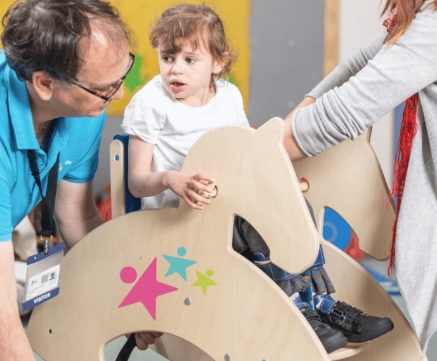


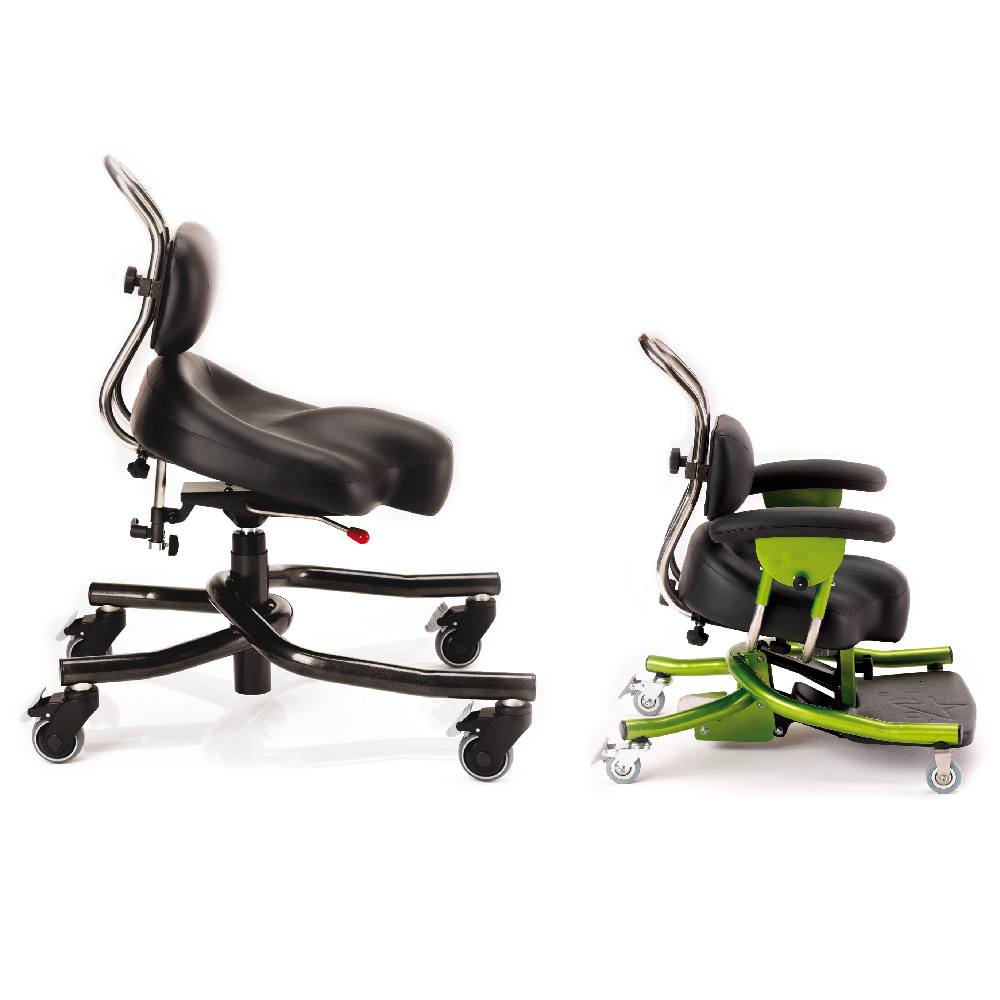
The Strato is a postural correction straddle seat for children with lower limb or trunk weakness. This guide explains the clinical principles behind its design, who it’s suitable for, how to fit it, and what we found in four user trials in schools in the South West of England.
Principles behind the Strato design
Strato is a straddle seating system. Its aims are achieved mainly through the contouring of the seat.
Aims of the Strato seat
- To provide a secure, stable base
- To promote postural control
- To facilitate functional efficiency
Principles of design
- The pelvis is the ‘keystone’ of the body structure and determines the posture above and below it.
- In sitting, the pelvis is unstable and relies on muscular activity to control its position. External control must be provided where internal control is inadequate.
- Extension of the upper trunk, shoulder girdle and head depends on pelvic stability, orientation and the existence of a lumbar curve, which itself depends on the position of the pelvis (Pope 1985; Zacharkow 1988).
- Stability of posture is essential for functional efficiency.
Key features
The straddle seat
Contoured to provide a wide base of support, promote a midline pelvic position and support the thighs. The straddle abducts the thighs and controls pelvic rotation, giving a stable base without the need for straps or knee blocks.
The back prompt
Not a support, but a ‘prompt’ that helps maintain pelvic position.
The armrests
Provided mainly to assist with transfers into and out of the seat.
The footplate
Optional, for when support other than the floor is needed.
Adjustable seat height
Allows use with different work surfaces and to suit the user’s needs.
Guidelines for prescribing the Strato
These are general guidelines and must not be applied rigidly. Prescription should always be considered on an individual basis, taking into account not only postural needs but also social, environmental and psychological factors.
General suitability
The Strato is designed for a child with:
- weakness or motor malfunction of the lower limbs or trunk, for example in hemiplegia, diplegia or other forms of paraplegia
- some postural control of the head and upper trunk
- sufficient abduction at the hip joint
It is suitable for any situation where an upright posture and functional efficiency are being encouraged, for example in a mainstream classroom.
Contra-indications
- Established contractures around the hip joint that prevent a straddle position
- Established significant kypho/scoliosis (in most cases)
- Insufficient postural control of the upper trunk and head
- Subluxation or dislocation of the hip joint in some cases where joint range is severely compromised. Where hip location is at risk, the pelvis and lower limb position encouraged by the Strato can support normal alignment and development.
Fitting and adjusting the Strato
-
- The Strato comes in five sizes. Choosing the correct size and adjusting it to the individual child’s needs is essential.
- The hip width should fit within the contours of the seat.
- Abduction at the hip joint must be sufficient to accommodate the pommel.
- The thighs should be fully supported.
- Adjust the seat to foot support or floor height so the feet are adequately supported.
- Select a seat incline to suit the individual, with respect to midline pelvic position and stability.
- Adjust the work surface height to match the seat if necessary.
User trials
The Strato was trialled with four children at special and mainstream schools in the South West of England. Each trial compared the child’s posture in their previous seating with their posture in the Strato. The full PDF includes photographs from each trial.
Case study 1: 5-year-old with diplegic cerebral palsy
- SettingSpecial school
- Strato sizeSize 2
- Seat angle0°
- Trial length6 days, about 3.5 hours a day
Background: She previously used a box stool with a Dycem top, but sensory issues made its hard surface difficult to tolerate. She needed pelvic stability to engage in classroom tasks, reach beyond her base of support and work towards independent transfers.
Results: On the box stool she sat with a posteriorly tilted pelvis, a flexed and asymmetrical spine, and thighs pulled together for stability. In the Strato, her thighs were abducted, her feet firmly supported, and her upper trunk balanced and extended with relaxed arms and a more symmetrical spine.
Supervising therapist: class staff liked its modern appearance, and therapists liked the range of adjustment, the angle of the lap strap and the functional posture it gave. “Everyone likes the green.”
Case study 2: 7-year-old with cerebral palsy
- SettingMainstream school
- Strato sizeSize 3
- Seat angle10° forward
- Trial length7 days, about 1.5 hours a day
Background: He previously used an activity chair. He needed a seat that kept his pelvis stable while encouraging a slight forward lean, to support independent transfers. The chair also needed to look at home in the classroom and be easy for staff to move.
Results: In his previous chair, the vertical backrest led to a flexed spine, neck extension and leaning on the armrest for stability. In the Strato he sat with an extended, balanced trunk over a wide and stable base, and a more upright overall posture during literacy and maths lessons.
Carer: the castors make it easy to move and the seat is comfortable. “Happy with the black.”
Case study 3: 11-year-old with quadriplegic cerebral palsy
- SettingMainstream school
- Strato sizeSize 3
- Seat angle10° forward
- Trial length14 days, about 5 hours a day
Background: His previous chair’s flat back and seat didn’t give support where he needed it, leading to a posteriorly tilted pelvis, kyphosis and chin poke. He has low tone in his trunk and increased tone in his limbs, and tires quickly, particularly in the afternoons, which affected his attention and hand function.
Results: In the Strato his head and upper trunk were extended and balanced over his pelvis, with no chin poke. After 15 minutes his spine remained aligned and relaxed, whereas in his previous chair his trunk rolled forward and his chin poke increased. The stable base also freed his arms for functional tasks rather than propping.
Supervising therapist: “Strato gives good pelvic and trunk stability and alignment. This was maintained throughout the trial.” Staff also valued that it’s lightweight, easy to move and adjust, and blends in with other classroom chairs. The child said his classmates thought it was cool and stylish.
Case study 4: 14-year-old with quadriplegic cerebral palsy and high tone
- SettingSpecial school
- Strato sizeSize 4
- Seat angle10° forward
Background: Following an adduction tenotomy, she used a bolster chair to keep her legs abducted, and a wheelchair that was more supportive than she needed. The Strato was trialled to improve her sitting balance and postural strength while helping her access the curriculum.
Results: In the Strato she sat with her head and trunk extended and balanced, feet firmly on the footplate, pelvis in anterior tilt and spine keeping its natural curves, with an erect, symmetrical posture.
Supervising therapist: this very functional position improved her upper limb function and head position for education, communication and interaction. Because the chair gives minimal support, she recruits her own postural muscles, making her an active participant in tasks rather than relying on the support of a wheelchair.
Summary
For all four children, the Strato appeared to be beneficial and helped them achieve a better posture throughout the trial.
Acknowledgements
Thank you to Vranch House School and Centre, Exeter, and Dame Hannah Rogers School, Ivybridge, for taking part in these trials. Thank you to Pauline Pope, Consultant Physiotherapist, for her input and development of the trial guidelines, and to the therapists, staff and parents of the children for their help and kind permission.
Find out more about Strato
Download the full clinical guidelines with trial photographs, or view the Strato product page. For advice on whether Strato is right for a child, get in touch with our team.