

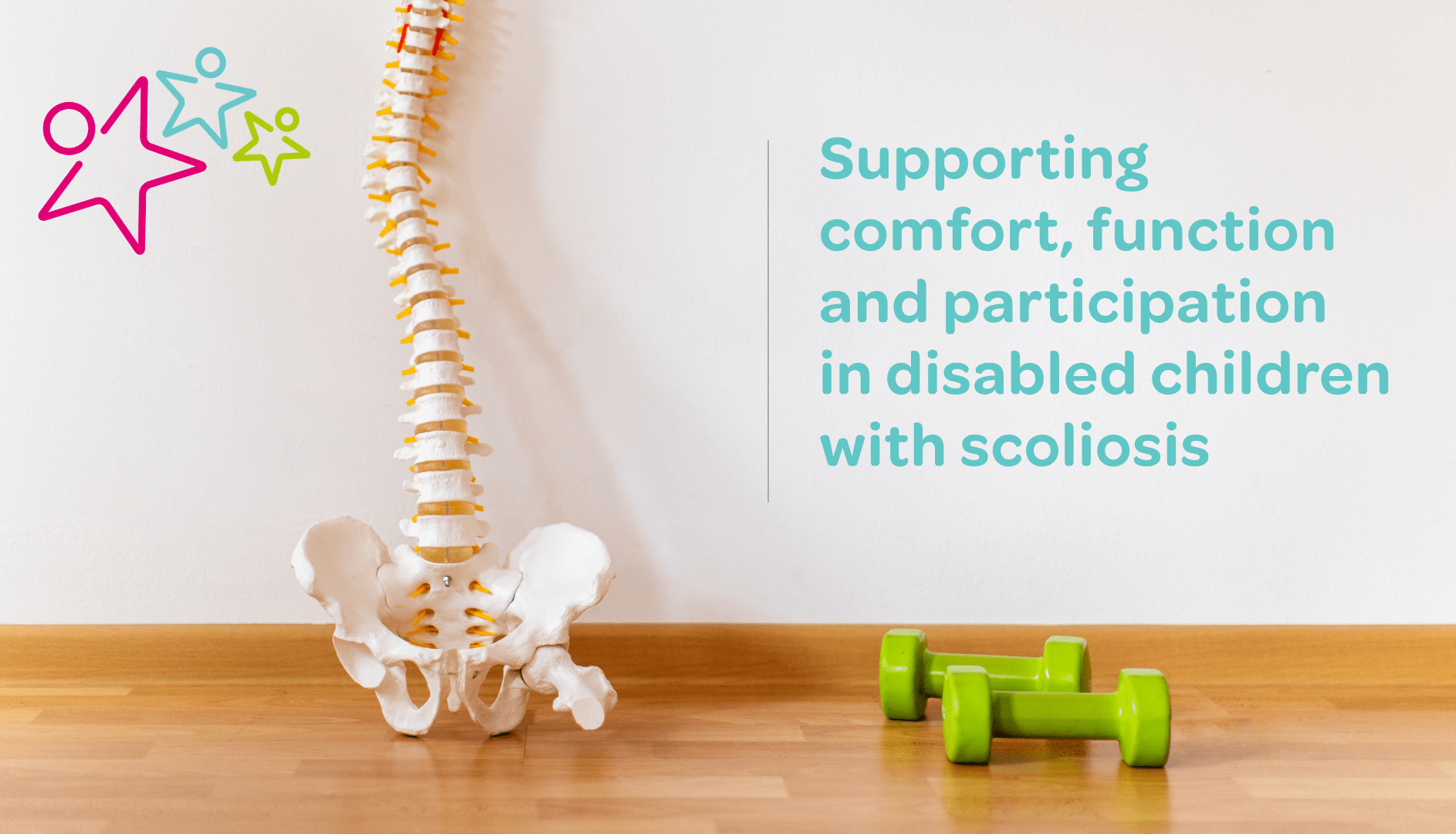
Supporting comfort, function and participation in disabled children with scoliosis.
“Scoliosis is not just a curve. It is a clinical issue, a functional issue and often a participation issue.”
SCOLIOSIS IS MORE THAN A SPINAL CURVE
Scoliosis Awareness Month is a useful reminder that scoliosis is not simply a spinal curve. For many disabled children, especially those with cerebral palsy, neuromuscular conditions or complex physical needs, scoliosis can affect comfort, sitting tolerance, breathing, digestion, pain, fatigue, access to learning, communication, play and family life.
As clinicians, it is easy to focus on the visible curve, the Cobb angle or the radiograph. Those measures matter. But they do not tell the whole story. The bigger question is often: how is this child’s posture affecting their ability to take part in everyday life? That question takes us beyond the curve.
A FUNCTIONAL AND PARTICIPATION-FOCUSED ISSUE
Children with cerebral palsy and other neuromuscular conditions are at increased risk of developing scoliosis, particularly those with greater motor involvement. Population-based research has shown that scoliosis incidence increases with age and is strongly associated with GMFCS level, with the highest risk in children at GMFCS V.
Management decisions should therefore consider the individual child, their family, the medical team and the wider multidisciplinary team. The aim is not simply to manage a curve, but to support sitting, function, comfort and quality of life.
This fits with the World Health Organization’s International Classification of Functioning, Disability and Health (ICF), which views disability as the interaction between body structures, activity, participation and environmental factors. It also aligns with CanChild’s F-words: Function, Family, Fitness, Fun, Friends and Future. Rosenbaum and Gorter’s well-known F-words paper challenged clinicians to move away from impairment-only thinking and focus on what matters in children’s real lives.
THE PELVIS MATTERS: THE CURVE RARELY STARTS WITH THE SPINE ALONE
In seating assessment, we often talk about the spine, but clinically we usually need to start lower down. The pelvis is the foundation for sitting posture. Pelvic obliquity, rotation, posterior tilt, windsweeping and hip asymmetry can all influence the trunk and spine.
This is why supportive seating should not be thought of as simply holding the trunk straight. It should begin with a careful assessment of pelvic position, hip range and comfort, spinal flexibility, head control, pressure risk, tone, movement patterns, fatigue, and the activities the child needs to access.
A child may not need more support everywhere. They may need the right support in the right places, allowing stability where it is needed and movement where it is useful.
SUPPORTIVE SEATING: NOT CORRECTION AT ALL COSTS
There is evidence that seating can influence spinal posture and scoliosis management, but the message needs nuance. Holmes and colleagues investigated special seating for non-ambulant children with spastic cerebral palsy and scoliosis. Their biomechanical study found that a carefully configured three-point force system using lateral supports produced greater static correction of spinal curvature than alternative lateral pad configurations.
More recent research comparing custom-contoured wheelchair seating with modular wheelchair seating in non-ambulant paediatric wheelchair users with neurological and neuromuscular disorders suggests that seating configuration may influence scoliosis progression, although scoliosis can still progress despite intervention.
This is important. Seating may help manage posture, improve comfort and slow progression in some children, but it should not be presented as a cure for scoliosis. The clinical aim should be realistic: support body shape, improve comfort, enable function and protect participation for as long as possible.
WHERE SMIRTHWAITE SEATING FITS IN
For children using Smirthwaite products, the clinical value of supportive seating is not just that a chair looks aligned. The value is what that alignment helps the child do.
In practice, supportive seating may help a child access classroom tasks, sit at an appropriate height with peers, use their hands more effectively, maintain eye gaze or communication access, reduce fatigue during learning, eat or drink in a safer and more comfortable position, and participate in play, table-top activity and family routines.
This is where supportive seating links directly to participation. A chair should not simply hold the child. It should help create the conditions for engagement, function and inclusion across home and school.
MOVEMENT STILL MATTERS
A common trap in scoliosis management is to assume that better posture means less movement. But stillness is not the goal. Children need opportunities to change position, move, stand, rest, play and participate.
Michelle Lange, an occupational therapist and recognised thought leader in seating and wheeled mobility, writes that our bodies are designed to move. Her work on dynamic seating argues that seating can sometimes provide movement for clinical benefit, including sensory input, alertness, reduced agitation, improved tolerance and function.
That does not mean every child with scoliosis needs dynamic seating. It means clinicians should avoid assuming that rigid control is always better. For some children, the right seating solution may need to stabilise the pelvis, support the trunk, manage asymmetry, reduce pressure and fatigue, allow safe functional movement, and support transitions into standing, therapy, play or rest.
SCOLIOSIS SUPPORT SHOULD BE PART OF 24-HOUR POSTURAL MANAGEMENT
Scoliosis does not only develop or progress while a child is sitting. Children spend their day across many positions: lying, sitting, standing, being transferred, travelling, sleeping, playing and learning.
Gericke’s consensus statement on postural management for children with cerebral palsy remains an important reference point, highlighting the importance of postural support across lying, sitting and standing. More recent reviews of 24-hour posture management recognise that people with complex physical disabilities who cannot change position independently are at risk of postural deformities and secondary complications, while also noting that the available evidence is often low quality because this is a complex area to study.
That nuance matters. We should not overclaim. But we should also recognise that doing nothing is not neutral. For children who cannot change position independently, prolonged asymmetry, poor support, fatigue and lack of movement opportunities can have real consequences.
PRACTICAL APPLICATION: QUESTIONS FOR CLINICIANS AND FAMILIES
When reviewing seating for a child with scoliosis, useful questions include:
• What is flexible and what is fixed?
• Can the pelvis be supported comfortably?
• Is the seating improving function, or simply making the child look straighter?
• Does the child appear more comfortable or more restricted?
• Can they breathe, swallow, look, reach and communicate more easily?
• Are lateral supports placed to support, not compress?
• Is pressure being monitored?
• Is the child able to access learning, play and social interaction?
• Does the seating work in real life for family and school staff?
• When was the last review, and has the child grown or changed?
• Are accessories such as pelvic supports, lateral supports, foot support, head support, trays and tables being used to support function rather than simply to control posture?
BEYOND THE CURVE
Scoliosis Awareness Month should absolutely raise awareness of spinal curvature, progression and the importance of early identification. But for disabled children, we need to go further.
Supportive seating has an important role to play, but its purpose is not simply to correct posture. Its purpose is to help children sit more comfortably, conserve energy, use their bodies more effectively and take part in everyday life.
So perhaps the most important question is not, how do we straighten the child? It is: how do we support this child to be comfortable, active, included and able to participate? That is what takes us beyond the curve.
A PRACTICAL 24-HOUR APPROACH MAY INCLUDE:
| Element | Practical purpose |
| Supportive seating | For school, meals, communication, play and table-top activity. |
| Supported lying and sleep | For rest, comfort, body shape protection and pressure care where needed. |
| Standing and movement opportunities | Where appropriate, to reduce sedentary time and support participation. |
| Transfer and care routines | Equipment choices that support safe, realistic daily routines. |
| Regular review | Because growth, tone, comfort and function can change quickly. |
| Participation-led goals | Goals linked to real life, not just alignment. |
A FINAL THOUGHT
Perhaps the value of looking beyond the curve is not that it gives us a single answer, but that it prompts better clinical questions. Not simply: Is the spine straighter? But: Is this child more comfortable? Less fatigued? Better able to communicate, learn, play and participate? These questions rely on therapists using their assessment skills, clinical reasoning and knowledge of the child’s everyday life to make thoughtful, individualised judgements. Because in the end, supportive seating is not just about managing scoliosis. It is about supporting a child’s right to participate.
Author:
Richard Harvey
Head of Clinical Business Development (UK)