

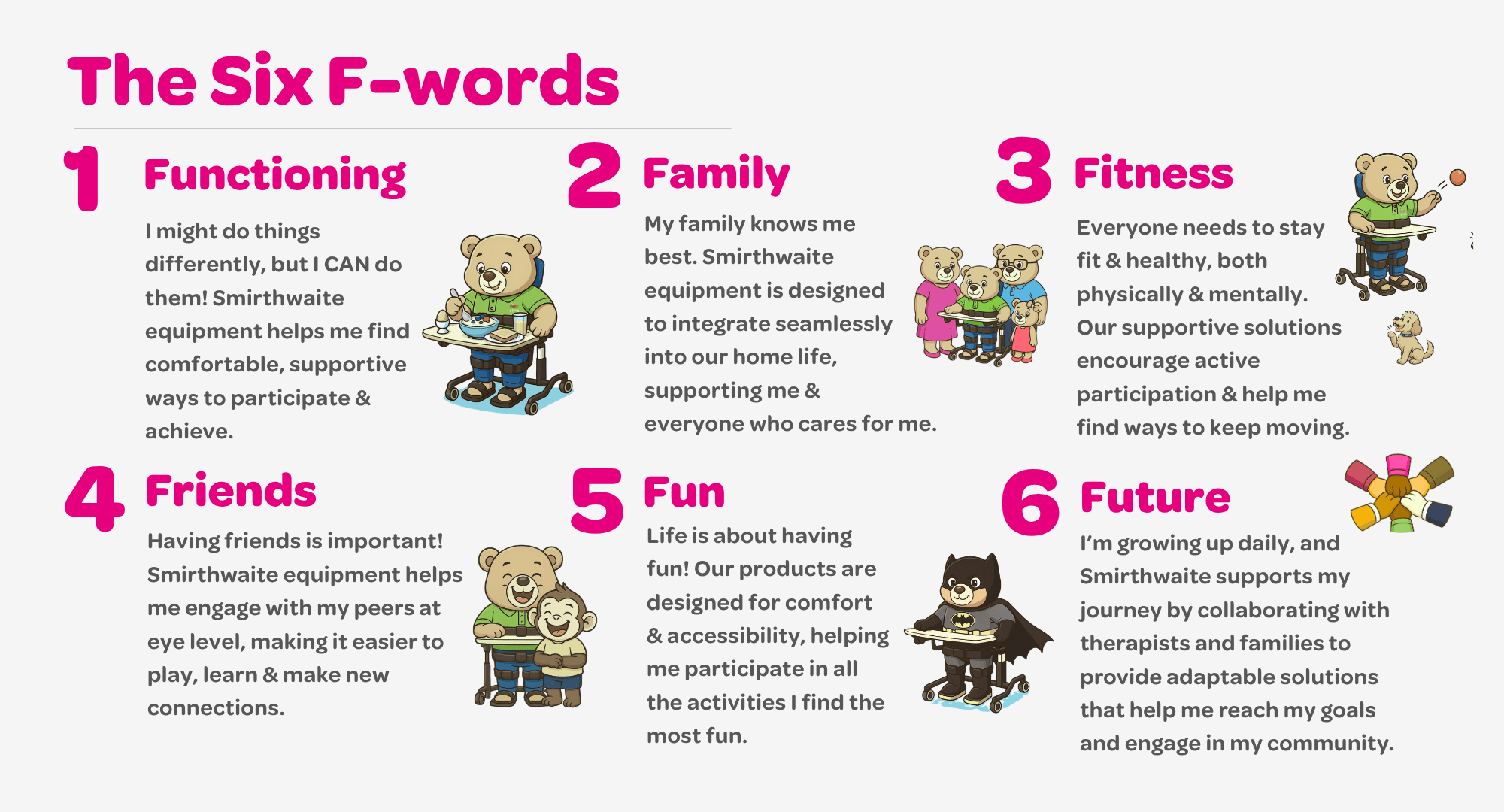
As occupational therapists, we have spent years talking about posture in terms of alignment, symmetry and protection. Those things still matter. But for children with disabilities, especially those who cannot change position independently, “good posture” should not be understood as holding a child still. It should be understood as creating the physical conditions for comfort, health, movement, participation and everyday life. That is much closer to the World Health Organisation’s ICF framework, which views functioning and disability as the interaction of body functions and structures, activities and participation, and environmental factors. It is also the thinking that sits behind CanChild’s F-words: Function, Family, Fitness, Fun, Friends and Future.
The original F-words paper by Rosenbaum and Gorter challenged clinicians to move away from diagnosis-led, impairment-only thinking and focus on what matters in children’s real lives. In their framing, function is what children do, family is the child’s central context, and fitness is a core but historically neglected part of childhood disability care. CanChild continues to describe the F-words as a strengths-based way of translating the ICF into language that is practical and meaningful for children, families and services.
That matters for postural management because posture is not the end goal. The end goal is what posture makes possible. A well-planned 24-hour postural management programme should support breathing, comfort, sleep, skin integrity, feeding, upper limb use, communication, access to play, learning and social participation. Osborne, Gowran and Casey’s scoping review notes that people who cannot change position independently are at risk of postural deformities and secondary complications, and concludes that although the research base is often low quality, many professionals agree that a 24-hour approach is essential.
This is where our language needs to shift. Good posture is not just about preventing deformity; it is about enabling a child to live an active life across the whole day and night. Sitting, lying, standing, stepping, transfers, play, floor time, powered mobility, outdoor activity and rest all belong in the same clinical conversation. If we isolate posture from activity, we miss the point. If we support posture well, we create more opportunities for movement, engagement and participation. That is both good occupational therapy and good evidence-based practice.
Postural management through the lens of the F-words
The F-words offer a useful way to explain postural management to families and multidisciplinary teams.
Function asks whether positioning helps the child do more. Can they see better, reach better, breathe more easily, communicate more effectively, use their hands with less effort, or tolerate activity for longer? The 2012 F-words paper explicitly links function to activity and participation, not simply to body structure.
Family reminds us that the best programme is the one a family can actually live with. A technically perfect setup that is burdensome, uncomfortable or unrealistic is unlikely to be sustained. Research on adaptive seating has found that parents and service providers reported reduced stress and burden, along with improved psychosocial well-being and quality of life, when appropriate seating was used.
Fitness is especially relevant during Postural Awareness Month. Rosenbaum and Gorter argued that fitness had been neglected in childhood disability. That point remains highly relevant. UK government guidance now recommends that disabled children and young people aim for around 20 minutes of physical activity per day, building up gradually, with strength and balance activities three times per week, and stresses that all movement counts and that activity should be enjoyable, inclusive and meaningful.
Fun and Friends help stop posture care from becoming a purely equipment-based exercise. A standing programme that lets a child join classmates at eye level, a supportive seat that frees the hands for art or play, or dynamic seating that allows movement and alertness during classroom activity may have more real-world value than a posture intervention judged only by alignment. CanChild’s description of the F-words keeps reminding us that development is about enjoyment, relationships and belonging, not only biomechanical correction.
Future asks the long-view question: what kind of life are we building toward? Good postural management can help preserve options by protecting body shape, supporting tolerance for activity, maintaining access to environments and reducing preventable secondary complications.
Why movement must sit inside a 24-hour programme
One of the biggest risks in posture care is treating it as static. Children need support, but they also need variation, transitions and opportunities to move. Michelle Lange has argued in her clinical publications on dynamic seating that movement itself can be therapeutic, helping with sensory input, alertness, agitation and function, rather than being treated as something that compromises positioning. That idea aligns strongly with contemporary occupational therapy thinking: the best positioning system is often the one that provides enough support for participation without removing the child’s ability to move.
The research on adaptive seating points in the same direction. Acharya and colleagues’ 2023 systematic review found limited but positive evidence that adaptive seating can improve sitting posture, postural control and seated activity performance in children with cerebral palsy, while also reporting family-perceived benefits. The important takeaway is not that seating alone “solves” posture, but that seating can create a platform for activity and participation when selected and used well.
Supported standing is another important part of the picture. Paleg, Smith and Glickman’s evidence-based review remains a key clinical paper for dosing paediatric supported standing programmes. More recently, McLean, Paleg and Livingstone’s scoping review reported that supported standing may influence outcomes such as bone mineral density, range of motion, hip stability, spasticity and activities of daily living in children and young adults with non-ambulant cerebral palsy, while also noting that stronger evidence is still needed.
Ginny Paleg’s 2024 paper with Williams and Livingstone is especially useful for this month’s message because it explicitly brings supported standing and stepping together through an F-words focus. That is a very practical bridge between theory and clinic: standing and stepping are not simply “positioning tasks”; they are ways to support fitness, function, fun, friendship opportunities and future participation. In other words, movement is not separate from posture care. It is one of its main purposes.
Hip health, body shape and the need for nuance
Of course, none of this means body structure is unimportant. It is very important. There is evidence linking prolonged asymmetrical postures, unsupported supine lying, windswept posture and long periods without position change to pain and hip problems in people with non-ambulant cerebral palsy. Paleg and Livingstone’s evidence-informed clinical perspective argues that postural management should be part of hip health work, even while acknowledging that high-quality evidence remains limited.
That nuance matters. The evidence for some postural interventions is promising but not definitive. Osborne’s 24-hour posture management review found the evidence base was often low quality. Acharya’s seating review found only a small proportion of included studies were of good quality. Toohey and colleagues’ 2024 umbrella systematic review similarly concluded that clinicians need evidence-based recommendations because multiple postural interventions exist, but the quality of evidence varies considerably across interventions.
For clinicians, that should not lead to paralysis. It should lead to better reasoning. We should be honest that the research is still developing, but we should also recognise that waiting for perfect trials is not realistic in a complex, highly individual area of practice. The answer is careful assessment, collaborative goal-setting, ongoing review, and selecting interventions that connect body structure goals with activity and participation outcomes.
What this means in practice
For me, as an OT working in postural management, the most helpful question is not, “How do we keep this child in a good position?” It is, “How do we use positioning across 24 hours to help this child be more comfortable, more active, more included and more able to do the things that matter?”
That means a strong 24-hour programme should usually include:
• supported lying for rest, sleep and body shape protection where needed
• supportive sitting that promotes access, communication, upper limb use and endurance
• standing and, where appropriate, stepping opportunities that reduce sedentary time and widen participation
• equipment choices that allow some movement rather than assuming stillness is always best
• goals written in functional, family-friendly language, not just biomechanical language.
Most importantly, it means we should stop separating posture from active lifestyle. For children with disabilities, posture care is not what happens instead of activity. Done well, it is what helps activity happen more often, more comfortably and more meaningfully. That is why movement deserves a central place in any 24-hour postural management programme. And that is why, during Postural Awareness or Good Posture Month, “good posture” should mean far more than sitting nicely. It should mean creating the conditions for children to move, play, join in and thrive.
Richard Harvey
Head of Clinical Business Development (UK)